
Finding Austin Residents
No single public roll lists everyone living in Austin. Start from what you already know. A current street address points first to the Travis Central Appraisal District. The City Property Profile map comes next. A name tied to a purchase or lien belongs with the Travis County Clerk's recording index instead. A past Austin household may surface in a city directory or a cemetery ledger. An archive series or a census source may hold it too. Keep those labels distinct. An appraisal owner, a deed party, and a court party are not the same thing. An organization contact and a historical householder differ from all three.
Work narrowly and keep the jurisdiction visible. Austin city services, Travis County offices, and Texas agencies each hold a different slice of the record. Federal courts, archives, and the postal service hold another. An Austin mailing label is not proof that an address sits inside Austin. It may not even sit inside Travis County. One address may need both a City route and a Travis County route. When a search produces a name, confirm it before drawing a conclusion. Use a second independent official source. Record dates, parcel or cause numbers, and source links make any result easier to check later.
- Confirm the exact address, city-limit status, county, and date that matter to the question.
- Search TCAD by property address, owner name, account number, or DBA when the inquiry concerns a parcel.
- Use the County Clerk index for recorded instruments, then retain the document number, date, and party role.
- For a historical household, compare a city directory year with the Austin History Center, Texas State Library, or County Archives holdings.
- When an online index stops, ask the named custodian for an existing record or an archive appointment rather than assuming the record does not exist.
Austin Resident Records Offices
The main sources behind any Austin residents directory sit in offices with separate jobs. The Travis County Clerk preserves recorded instruments and publishes the public recording index. TCAD supplies the appraisal-account view. The City Property Profile map adds parcel and boundary context. The Travis County voter lookup checks one individual's status rather than a whole street. Some historical formats online portals never replace. For those, the Austin History Center and Travis County Archives are the holders.
Travis County Clerk, Recording Division
5501 Airport Blvd Ste 100B
Austin, TX 78751
512-854-9188, option 7
Travis Central Appraisal District
Property accounts and appraisal data
Travis County, Texas
Use the current district contact listing
Travis County Voter Registration
2433 Ridgepoint Drive
Austin, TX 78754
512-854-9473
For an address-led search, the fuller parcel sequence lives on the Austin street directory page. An office name alone never proves who occupies an Austin property today.
Austin Property Roll Searches
For any Austin parcel question in Travis County, TCAD is the first official stop. Its property search accepts owner name, property address, account number, DBA, and a map route. The district tells Austin searchers to drop suffixes and expect abbreviations. So a shorter name or a street-only query often rescues a failed exact match. Save the account number and situs address. Then compare the result against a recorded instrument or a City GIS feature.
An Austin appraisal account is the district's tax and valuation record. It proves no title and no current occupancy. A tax mailing address may not be where anyone lives. TCAD notes that current-year work is in progress. Prior-year data is informational. The public data carries no warranty. Treat the account as a precise starting point. Then test it against the Clerk's index and the Austin City map.
| TCAD field | How Austin searches use it |
|---|---|
| Owner Name | Optional text field; omit suffixes and broaden fewer words when names vary. |
| Property Address | Optional text field; a street-only search can broaden a missed address. |
| Account Number | Use the exact value from a prior parcel card when available. |
| DBA | Business or assumed-name option, not evidence of a personal residence. |
| Map Search | Opens a mapping route whose live fields can change. |
Travis County Deed Trails
The County Clerk's public-record search is a finding aid for Austin deeds and liens. It also covers plats and related instruments. Quick and Advanced Search cover Land Records, grantor and grantee terms, and subdivision. They also reach document type or number, recorded-date ranges, and a choice between Index Only and Index & Full Text/OCR. A strong Austin record trail checks both grantor and grantee directions. Add initials, married or maiden forms, and the legal subdivision. Do this when a surname search runs thin.
Most online Austin recording index data runs from the mid-1980s to the present. The Clerk and Austin archives keep the earlier books, microfilm, and historical series. An online print may be unofficial and watermarked, and redactions can apply. A Clerk-made copy is listed at $1 per page. A certified copy adds a $5 certification fee plus copy charges. Because schedules change, recheck the current Clerk fee information before ordering.
- Index
- A finding tool that points to a recorded instrument, not the certified underlying record.
- Grantor and grantee
- The party giving an interest and the party receiving it in a recorded instrument.
- Parcel
- A mapped property unit, often joined across systems through an account number and legal description.
- Criss-cross directory
- A historical address-to-name directory that can support, but not prove, past occupancy.
Note: A legal description or instrument number bridges records far better than a street name that may have changed over time.
Current Austin Resident Directories
Current evidence in any Austin resident directory is record-specific. TCAD can show an appraisal owner and parcel context. The Clerk index records instrument parties. The Austin voter lookup confirms an individual's registration status under its own rules. Courts, licenses, and organization registries each show a different relationship to a source. None of them is a complete roster of an Austin household, let alone the city.
| Source | Record role | Keeper | Access route |
|---|---|---|---|
| Appraisal account | Owner, account, situs, values, and parcel clues | TCAD | Free name, address, account, or DBA search |
| Recording index | Grantor, grantee, document, date, legal description | Travis County Clerk | Online index, Clerk copies, older microfilm |
| Voter lookup | Individual registration or status response | Travis County | First name, last name, and birth date required |
| Community Registry | Organization contact, stated boundary, meeting data | City of Austin | Organization name or five-digit ZIP search |
| Public court portals | Party role, cause, setting, and record route | County, District, or Municipal Court | Portal plus custodian copy request |
A person-first question calls for careful comparison of these source roles. The Austin resident lookup page lays out that verification sequence and its limits.
Austin Voter Status Route
The Travis County voter lookup is the tool of record. Use it for an Austin identity and status check. It asks for a first name and a last name. It also needs a birth date entered in a specific format. Keep it separate from a formal Texas Secretary of State voter-file request. Texas rules shield Social Security numbers, driver-license or PID data, and certain addresses. Travis County also offers an Austin web-suppression form. The Texas Attorney General runs an Address Confidentiality Program for eligible participants. The Travis voter lookup is the official source for this route.
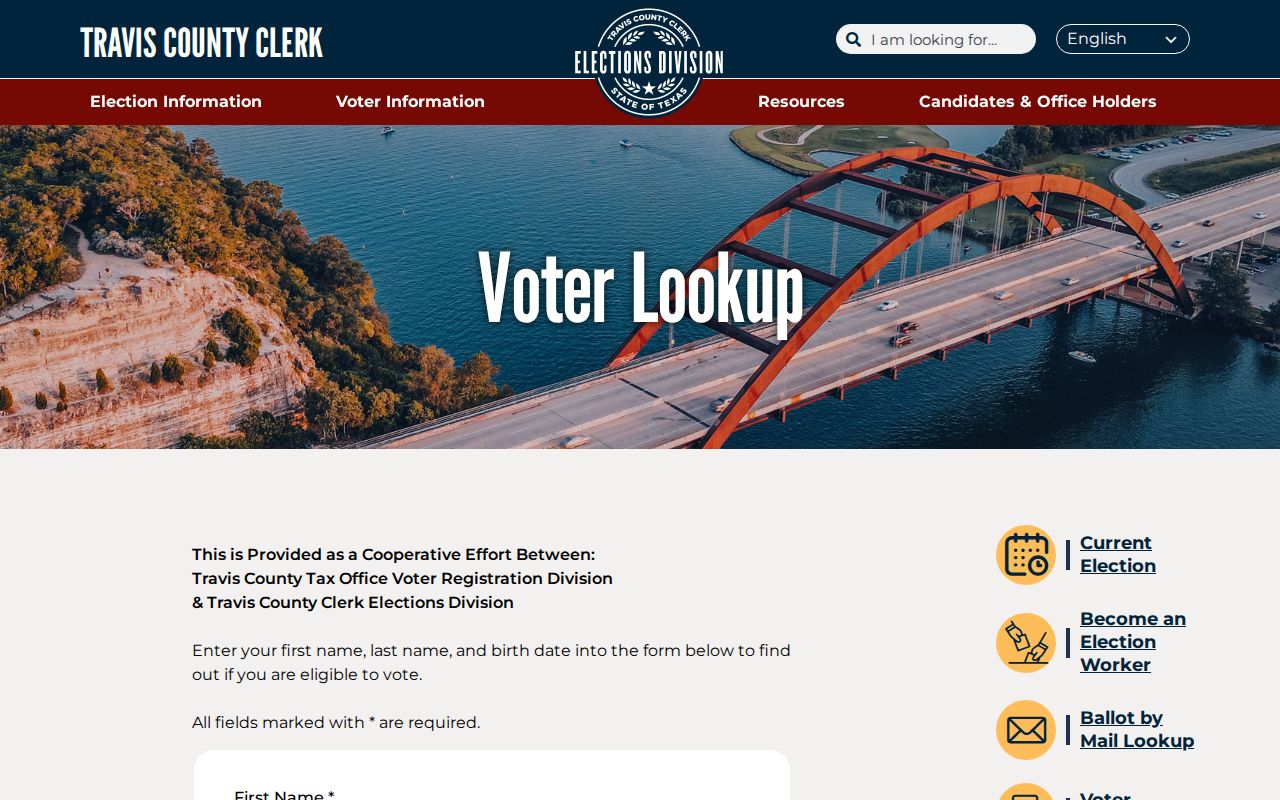
The service clearly demands individual identifiers. It is not a lawful way to assemble a street, block, or household list for Austin.
Austin Court Search Routes
Austin court records split by court and case type. The Odyssey route accepts a record number or a Last, First Middle name search. Hearing and location filters cover the County Clerk, District Clerk, and Probate Court. The District Clerk posts online Family and Civil coverage from 2006 forward. Criminal coverage runs from 2008 forward. Austin Municipal Court handles city traffic, ordinance, juvenile, disabled-parking, and Class C matters. It runs its own search and request process. A docket name alone proves nothing about identity or current residence in Austin. Travis criminal docket entries carry defendant, attorney, cause, date and time, courthouse instruction, court, floor, type, and matter. Verify the court, case number, party role, date, and any public document route. Earlier, sealed, juvenile, expunged, and protected records require the custodian's own access process. Statewide re:SearchTX and federal PACER serve as discovery routes. Each has distinct Austin coverage and access limits.
Austin Vital Record Requests
An Austin vital-record request starts with where and when the event happened. The Travis County Clerk holds local birth and death records for 1903 through 1956. Events inside Austin city limits route to City of Austin Vital Records. Events elsewhere in the county can go to the relevant justice of the peace. Other Texas events route to DSHS. The County page lists $22 for a certified birth copy. It also lists $20 for a certified death copy. Confirm current Austin charges and methods before filing. The Travis County Clerk vital statistics page supplies the local routing details.
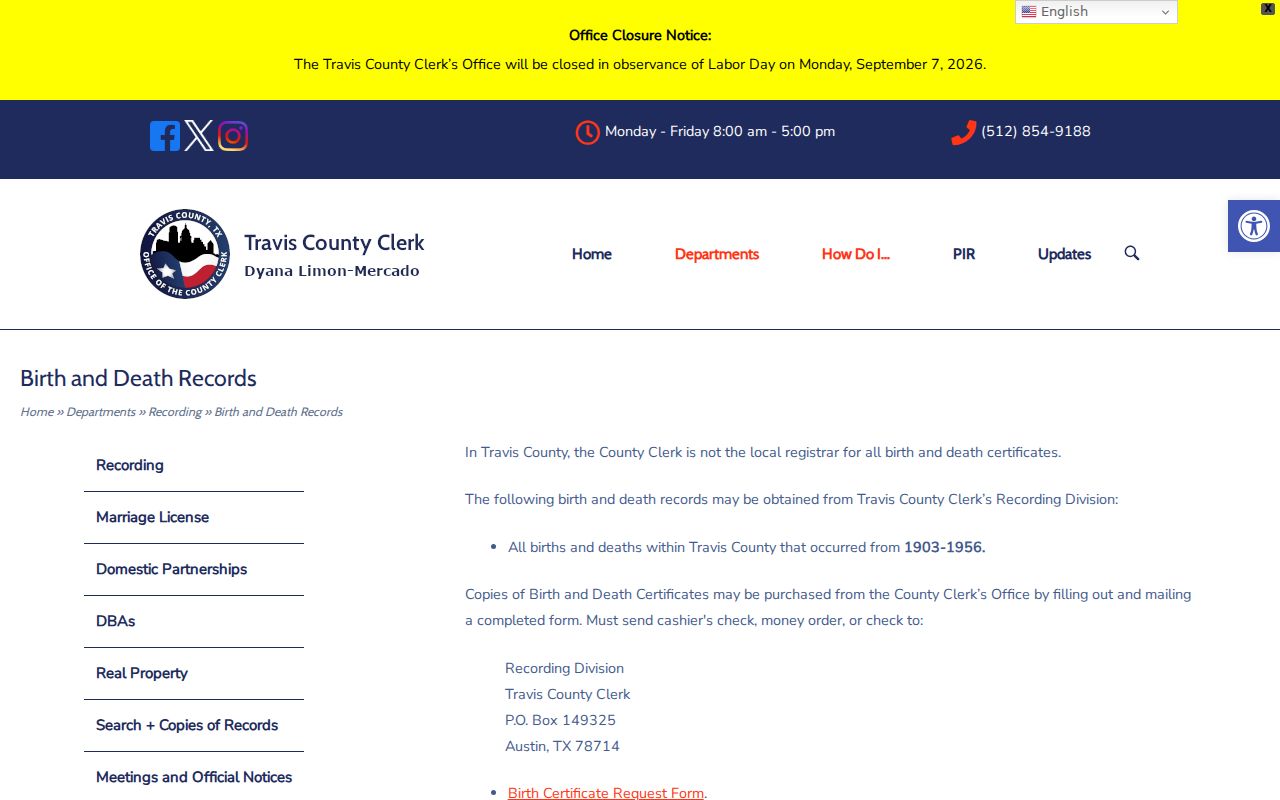
The page helps you pick the right local custodian before filling out any application. DSHS sets a 75-year wait before Austin birth records become public. Austin death records open after 25 years, subject to record type and law. More recent copies require a qualified immediate family member or documented direct, tangible interest. An Austin verification letter is not a certified record. The state forms page carries the current VS-140 birth, VS-142 death, marriage or divorce, correction, adoption, and paternity routes. Texas DSHS vital applications and forms is the official state starting point.
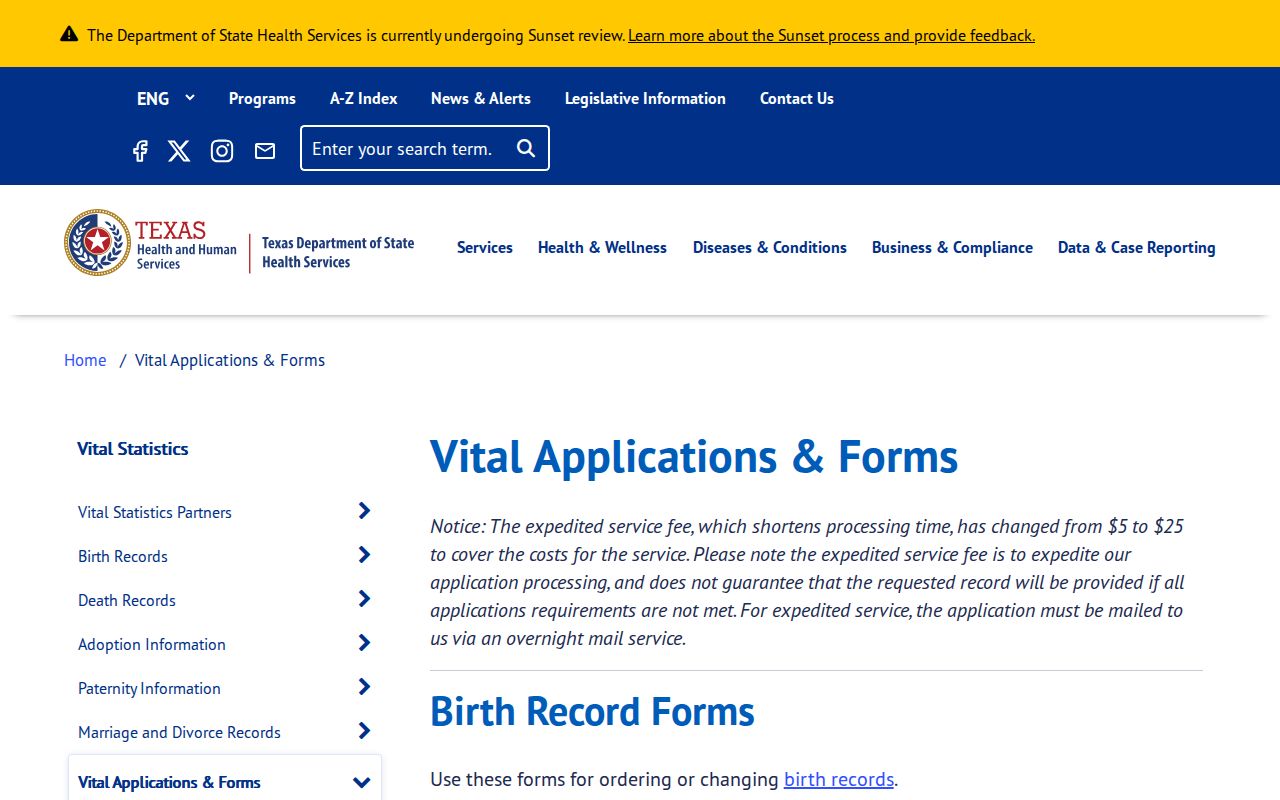
The state form list separates a simple certificate request from a restricted, specialized, or correction process.
Austin License and Filing Checks
A Texas credential or filing tied to Austin can confirm a professional, entity, or recorded business role. It will not confirm anyone's home address. DSHS license search offers name, license type, city, county, and license-number modes for covered programs. The Texas Medical Board, TEA, State Bar, and other boards run their own scope-limited systems. For Austin business records, SOSDirect provides entity search, filings, copies, and certificates. Travis County's DBA route covers unincorporated assumed names. Incorporated assumed-name rules differ. Texas Secretary of State business services provides the official SOSDirect entry point.
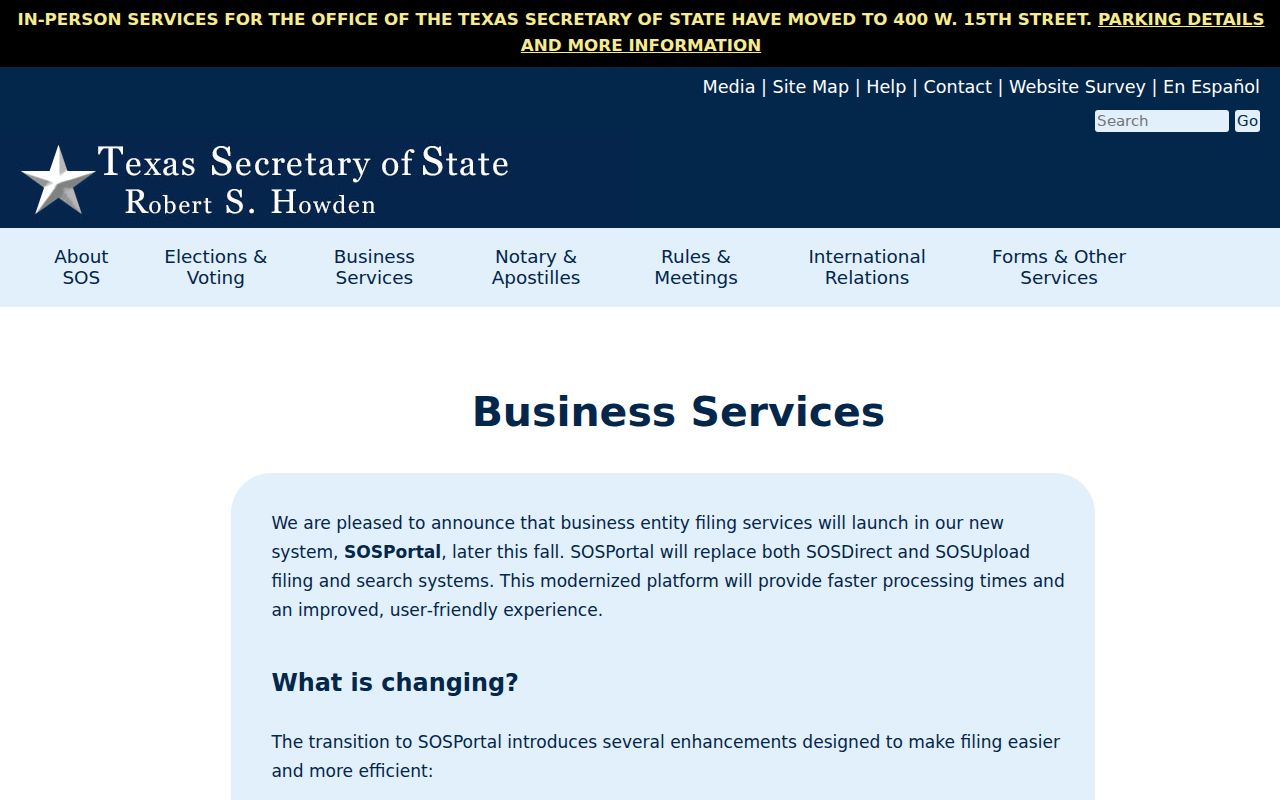
Use an entity name and filing details to describe a business record. Do not infer an Austin residence or personal ownership beyond what the record itself states.
Austin Boundary Checks
Austin, Travis County, an Austin postal city label, an Austin ZIP polygon, and a historical Austin jurisdiction are separate layers. The City ZIP map identifies postal ZIPs wholly or partly inside city limits. These include 787xx and edge 786xx areas. That does not make every address in those ZIPs part of Austin. The Austin City ZIP GIS layer supplies ZIPCODE, CITY, STATE, and geometry fields. The City directs postal ZIP questions to USPS. Check the exact address in the map and retain the source date. City Address Management covers Austin, unincorporated Travis County, and several nearby municipalities. Yet it does not maintain ZIP codes. Annexation, disannexation, street renaming, and address reassignment can shift which city or county source fits an older record. A full address history should preserve the original street string, direction, type, unit, legal parcel description, and date.
Austin's Three Record Eras
Scale shapes everything here. The 2020 census put Austin at 961,855 people. The 2024 estimate reached 993,588. Growth that fast means current records live in busy online portals. Much older material sits on shelves, microfilm, or scattered scans. The County Clerk's permanent library and the Travis County Archives both hold series predating any online search.
Local research falls into three eras. Books and microfilm come first. Indexed digital systems come next. Then live online images and maps arrive. The Travis County Archives lists some very specific runs. Tax rolls span 1840 to 1995. Land registers run 1877 to 1936, and city lot registers 1879 to 1974. Inquests cover 1887 to 1977. So a no-result online often reflects format or coverage, not a true absence of records. The FY 2026 digitization recommendation is only a proposal. It does not make older paper searchable.
Historic Austin Resident Directories
Printed Austin directories reach back to the 1872-73 era. The runs continue into the twentieth century, though gaps interrupt them. Three repositories matter here. The Austin History Center, the Texas State Library, and UT's Briscoe Center each hold editions. The editions overlap, and they do not match one another. Briscoe lists a series running from 1889 through 1958. The Austin History Center's biographical guide describes Criss-Cross directories starting in 1957, also with gaps. A few volumes are digitized online. Many still require a Reading Room visit, microform, or an archive trip.
Treat these books as dated snapshots. They are not a permanent record of who lived in Austin. An entry might carry a name, occupation, address, phone, a street section, or a cross-reference. What appears depends on the edition. The Austin History Center points out that address cross-references commonly appear after 1905. Its preservation guidance also warns that data may have been gathered before the publication year. For the full collection, entry-reading method, and repository choices, see the Austin city directory section.
Note: Keep a directory edition year, page, exact address wording, and repository with every lead. Record each one with every historical household entry.
Austin Source Limits
Austin records earn trust because the custodian and the scope are clear. A single result rarely settles anything. An appraisal rolls entry may list a trust rather than a person. A deed party could be a grantor, a grantee, an heir, or an attorney-in-fact. Court captions sometimes carry only a filing address. Directory entries can be old or incomplete. So work from at least two independent official Austin sources where you can. Keep the record label intact. State plainly when a result fails to resolve identity, Austin city limits, current occupancy, or a protected field.
Chapter 552 of the Texas Government Code governs requests. It covers only information that already exists. The Travis County public information request route notes that staff will not create a record, answer general questions, or perform legal research. Name the record series, date range, document, parcel, or case number you want. Read any cost estimate, redaction, or exception notice before you lean on the answer.