
Austin Resident Lookup Record Coverage
There is no single current roll of Austin residents. The useful question is what a record can actually establish. An Austin property question can draw on Austin TCAD, while an Austin case question belongs in the Austin court system. A Travis Central Appraisal District property search can connect a name to an appraisal account, parcel, situs address, and possible tax mailing address. The Travis County Clerk recording index can identify a recorded party, legal tract, instrument date, and document number. The Travis voter tool and court systems add status or case context, each with separate limits.
| Record | What it can establish | Austin or Travis custodian | Access boundary |
|---|---|---|---|
| Austin TCAD appraisal account | Account owner, Austin parcel, property address, and possible tax mailing address | Austin-area TCAD property search | Public search, but an appraisal entry is not proof of current residence. |
| Austin recorded deed or lien | Recorded party role, legal tract, instrument date and number | Travis County Clerk for Austin records | Online index is largely mid-1980s forward; older books and microfilm remain an Austin research fallback. |
| Austin voter registration | Individual registration or status response | Austin-area Travis County voter lookup | Requires first name, last name, and birth date; protected fields and suppression rules apply. |
| Austin court case | Party role, cause, court, filing or setting, and public document route | Austin county, district, municipal, statewide, or federal court | Coverage differs by court; sealed, juvenile, expunged, adoption, and protected material remain restricted. |
| Austin vital event | Event name, date, and county, or an eligible certified record | County Clerk, Austin Vital Records, or DSHS | Recent records have relationship and direct-tangible-interest limits. |
| Austin historical collection | Earlier address, classmate, burial, or family-history clue | Austin History Center, Texas State Library, and County Archives | Edition gaps and archive access limits mean an Austin historical entry is not present-status proof. |
Choose the narrowest official source that answers the question. An Austin parcel question starts with Austin TCAD. An Austin case question starts with the appropriate Austin court. An Austin family-history question may need a directory, cemetery ledger, archive, or vital-record route. Preserve the role printed in the source, such as grantee, party, registrant, or decedent, rather than relabeling it as a current resident.
Austin Resident Lookup Court Names
For Austin county cases, the Travis County courts page separates District Clerk, County Clerk, probate, criminal, civil, family, juvenile, and Justice of the Peace functions. Austin Odyssey Smart Search accepts a record number or a name entered as Last, First Middle. Its hearing and advanced filters can narrow by County Clerk, District Clerk, Probate Court, and hearing date. Austin District Clerk online coverage published in the research is family and civil from 2006 forward and criminal from 2008 forward. A name hit is a lead, not an identity match.
The city-level Austin route is Austin Municipal Court Search My Case, which uses a last name with date of birth or driver-license number for citation handling. Austin Municipal Court handles traffic, city-ordinance, juvenile, disabled-parking, and Class C matters. The public page did not state an exact historical cutoff. For an Austin case record, use the case number, court, filing date, and party role. Court captions can carry old filing or counsel addresses, and a docket setting is not a finding of liability or guilt.
The Austin Municipal Court case-search screen shows the official Austin resident lookup route for municipal matters.
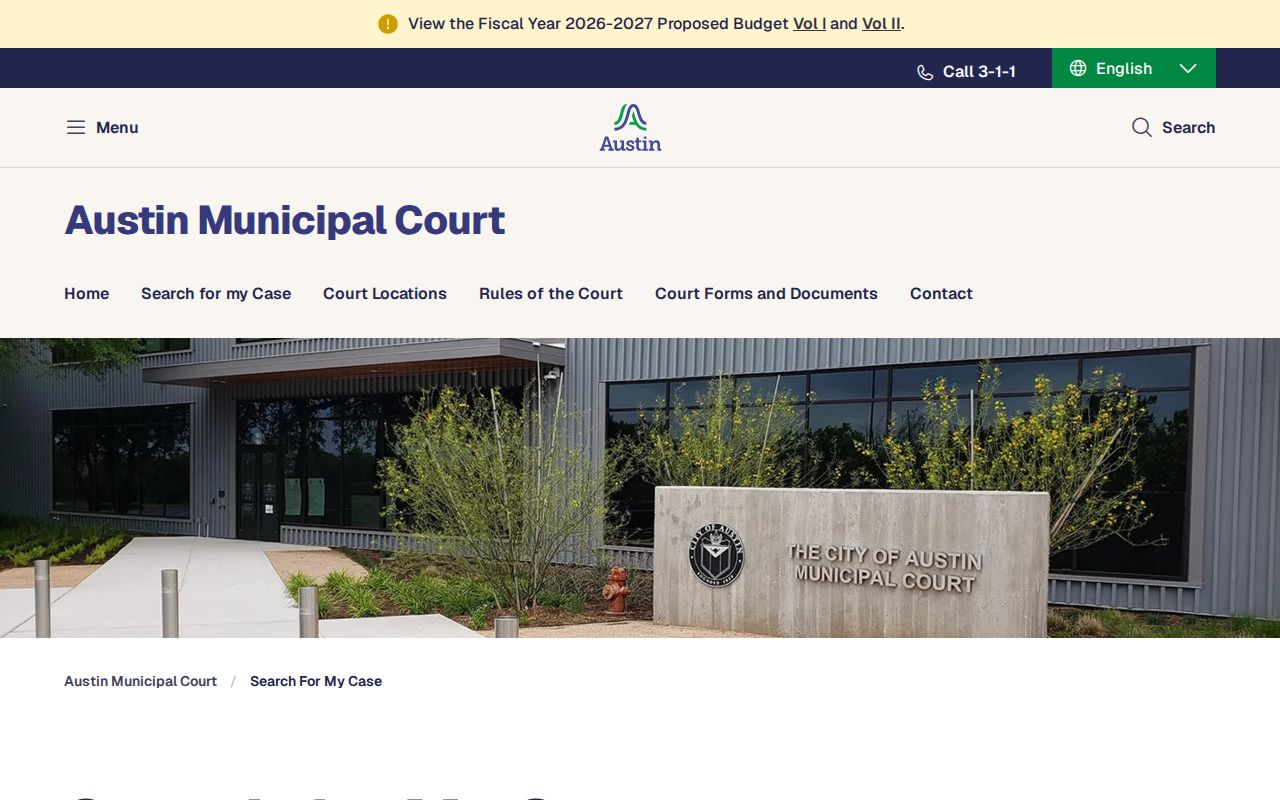
Use the search result to capture an Austin case reference and then confirm the available Austin record through the court, rather than treating the screen as a complete personal history.
The observed Travis criminal docket offers Austin searchers a useful sample inventory for a different court route. Its visible columns are Defendant and Attorney, Cause, Date and Time, Appear at Courthouse, Court and Floor, plus Type and Matter. A linked file or image is not guaranteed, and disposition is not a universal docket column. Request the file from the Travis County or Austin District Clerk route when the actual document is needed.
| Defendant and Attorney | Display names for a party and representative, not a unique identity key. |
|---|---|
| Cause | The cause or case identifier needed for a clerk follow-up. |
| Date and Time | A docket-setting timestamp, not necessarily the filing or outcome date. |
| Court and Floor | The court and room-related location fields shown for the setting. |
| Type and Matter | The event classification and matter description presented in the docket. |
Note: Court search screens can lag new data and never replace the custodian's access rules for restricted documents.
Verify an Austin Resident Across Records
A careful Austin resident lookup relies on two independent records that share a meaningful detail. Start with an Austin name, known variants, an approximate time, and the correct Austin jurisdiction. The strongest comparison is not two copies of the same index. Pair an Austin TCAD account with an Austin recorded instrument, or pair an Austin historical directory entry with a dated cemetery or census source. If only a common name appears, leave the match unresolved. An Austin parcel owner, court party, voter registrant, license holder, and organization contact can all be different roles for the same person or different people with the same name.
- Define the Austin name, middle initial or suffix variants, time period, jurisdiction, and the limited question being checked.
- Search one Austin official system and retain its field labels, record ID, source date, status, and disclaimer.
- Compare an Austin address or date with a second independent official source, keeping the source-specific role intact.
- When Austin records align, ask the named custodian for a clerk-made or certified copy only if the record and request are available to you.
- If an Austin result does not align, record the conflict. Spelling, privacy, coverage, and digitization gaps can all cause a no-result.
- Docket
- A court's running list of case settings and events. A docket entry can be a useful date and case lead, but it is not the whole file.
- Index and image
- An index helps locate a record by fields such as name, date, or instrument number. An image is the scanned document itself and can have different access rules.
- Certified copy
- A copy issued and certified by the custodian. It is different from an unofficial online printout or a search result.
Austin Resident Lookup Vital Routes
Austin vital-record access depends on where the event happened and how old the record is. The Travis County Clerk lists Travis County birth and death records for Austin-area events from 1903 through 1956. Birth or death events inside Austin city limits go to Austin Vital Records. Events elsewhere in Travis County go to the relevant Justice of the Peace, while other Texas events go to the Texas Department of State Health Services. The County Clerk's listed prices were $22 for a certified birth certificate and $20 for a certified death certificate when reviewed, so current fees and submission options for Austin requests should be checked before filing.
DSHS request procedures state that birth records for Austin events become public after 75 years and death records for Austin events after 25 years, subject to the record type and applicable rules. For newer Austin records, DSHS limits access to immediate family or a person with documented direct, tangible interest. The current VS-140 and VS-142 forms call for identity, signature, and, for mailed requests, a notary section. A verification letter for an Austin event can identify the person, event date, and county, but it is not a legal substitute for a certified certificate.
When an Austin online trail ends, use the Austin custodian's mail, walk-in, online, phone, or written-request channel shown for that record type. Do not post identification documents, signature pages, payment details, or any form field that could expose a private credential.
Austin Resident Lookup Family-History Clues
Austin family-history work needs dated evidence rather than a guess about a living person's status. The Austin History Center genealogy and people-search resources, Austin city directories, cemetery records, County Archives, and HeritageQuest can create an Austin timeline of names, addresses, family references, and place. Austin directories run from 1872 forward with gaps. After 1905, many editions include an address cross-reference, while older entries may require the alphabetical section. The collection year and publication year can differ.
For an Austin heir, classmate, or early Austin name, save the exact spelling, edition, page, and date. Then seek a second Austin source, such as a cemetery entry, probate cause, census record, or qualifying vital record. The County Archives holds series useful for Austin research, including tax rolls from 1840 to 1995, land registers, city lot registers, school records, inquests, naturalization material, and early marriage and death material. Some sources are analog, appointment-only, indexed differently, or restricted. An Austin historical address or directory entry is a lead, not proof of a current location.
Austin Resident Lookup Professional Records
When an Austin question concerns a public credential, use the regulator that issued it. The Texas occupational-license portal routes Austin searchers to state boards. The DSHS license search supports name, license type, city, county, and license-number searches, with results that can include name, type, status, and expiration. Texas Medical Board profiles update daily, and the Texas State Bar directory accepts first name, last name, law firm, practice area, or advanced search fields. These are professional-regulatory records. A listed business or mailing location is not proof of an Austin residence.
For an Austin entity or assumed name, use Texas SOSDirect or the Austin-area County Clerk DBA route. An Austin entity filing, UCC record, or registered-agent listing should retain its filing role and source date. It should not be converted into a personal address claim.
Austin Resident Lookup Request Fallbacks
A missing Austin portal result may mean the record is older, spelled differently, restricted, or not digitized. The Travis County Clerk describes online recording data as largely mid-1980s to present, with older books and microfilm available through the office and Austin archival routes. Austin probate records have an automated cause and status route after July 1992, while earlier material has a microfilm fallback. For Austin court records, the District Clerk lists online, mail, in-person, and public-information channels. Austin Municipal Court also offers phone, email, mail, and counter routes for records requests.
Under the Travis County public-information request process and the Texas Public Information Act, Government Code Chapter 552, ask for an existing Austin record, date range, format, case or instrument number, and relevant name. County staff do not have to create information, answer broad questions, or conduct legal research. The Texas Attorney General's PIA overview explains that exceptions, redactions, estimates, and ruling routes can apply. Keep each Austin request, clarification, estimate, and production date with the resulting record.
Note: An official request is strongest when it identifies a custodian and record series instead of asking for a narrative answer.
Austin Resident Lookup Privacy Limits
Austin public-record access has boundaries. Austin voter information protects Social Security, driver-license or personal-identification fields, certain addresses, and protected-voter data. Court access rules can restrict sealed, expunged, non-disclosed, juvenile, adoption, mental-health, victim, and protected-party records. The Texas Address Confidentiality Program supplies a substitute mailing address and controlled disclosure for qualifying survivors. Do not try to identify or publish a participant's actual address.
Data minimization matters even when an Austin record field is visible. Preserve the Austin record type, source, date, jurisdiction, and safe official link. Leave out full street addresses, phone numbers, email, birth dates, identification numbers, victim details, and other sensitive information unless there is a clear legal and practical reason to handle it through the custodian. The Austin public trail can support family history, estate research, civic questions, and fraud prevention without becoming a tool for targeting someone.
Lawful use. Use Austin records for personal, lawful research and respect each custodian's limits. Do not use a result to stalk, harass, threaten, intimidate, or expose a protected person.