
Austin City Directory Holdings by Repository
Austin directory research works best as a shelf-by-shelf check, not as one supposedly complete run. The Austin History Center, Texas State Library and Archives Commission, and UT Briscoe Center overlap, yet their holdings are not identical. The Austin History Center describes directories from 1872 forward with gaps, while the Briscoe series covers 1889 through 1958 and includes Austin, Rollingwood, and West Lake Hills editions. Texas State Library holdings are useful when a needed edition is absent elsewhere. Selected early volumes are online, but many searches still begin with a catalog, microform, or a Reading Room visit.
| Repository or collection | Located years | Format | Access route |
|---|---|---|---|
| Austin city directories | 1872-73 through later listings to 1992, with gaps | Print, microform, selected scans | Austin History Center, TSL, Briscoe, and Portal to Texas History |
| Briscoe Austin directory series | 1889-1958 | Repository series | UT Briscoe citation and finding page |
| Criss-Cross directories | From 1957, with gaps | Address-order volumes | Austin History Center, confirm edition in person |
| Austin telephone directories | 1905-present, with gaps | Historical telephone volumes | Austin History Center |
| Travis County directories | 1894-95, 1898-99, 1901, 1954-62, 1972 | County context volumes | Austin History Center |
The Austin History Center genealogy and people-search landing page is a useful first stop for historical-directory research and related local collections.
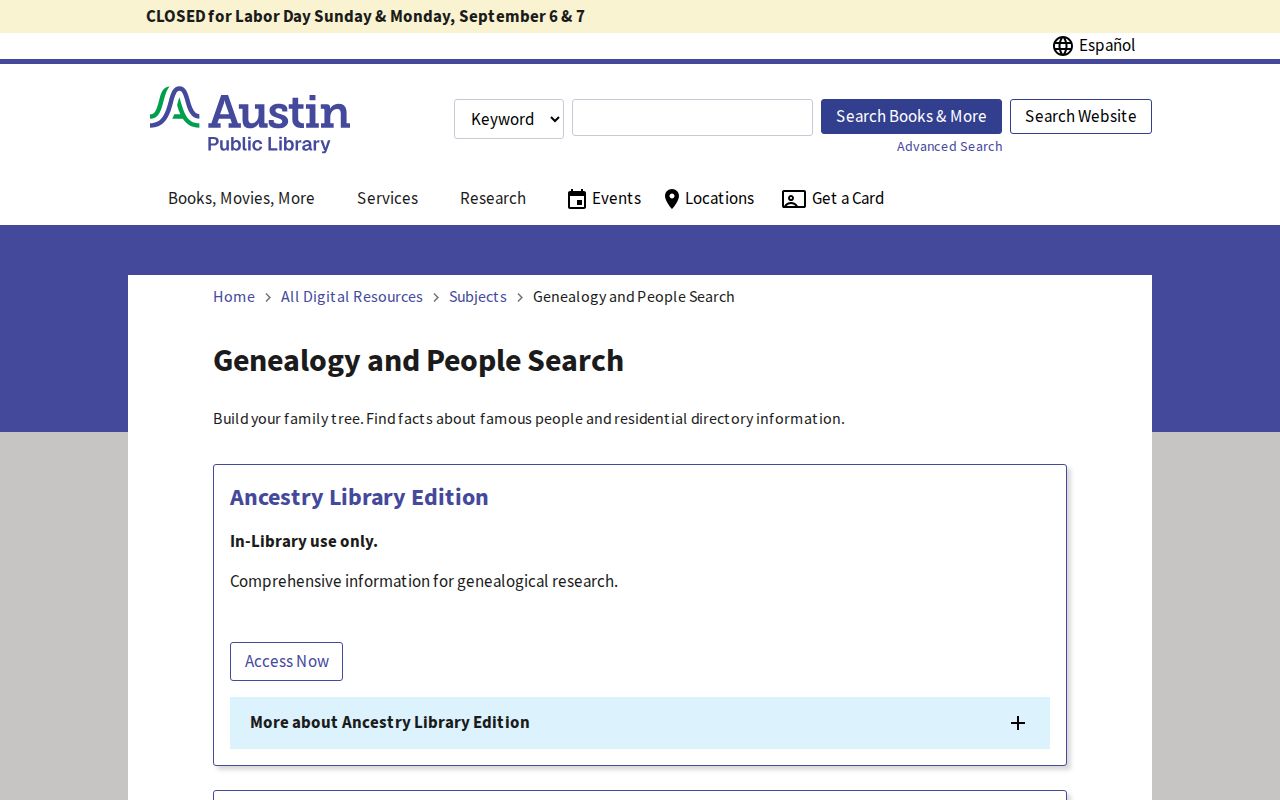
The Austin History Center also points researchers to census, local-history, church, military, court, land, and probate materials. Those sources can confirm a date or relationship that one directory entry cannot establish.
Compare Austin repository lists before ordering a copy or arranging a visit. The Briscoe series has many, but not all, years through 1958; AHC and TSL extend the date range differently. A gap in one list may be a holding at another institution, while a gap across all three should remain a documented gap rather than an invented continuous run.
Austin's 1872-73 Digitized Directory
The 1872-73 Gray & Moore directory is a particularly concrete Austin starting point. The Portal to Texas History presents the Austin History Center-provided item as a 148-page volume with OCR and page images. Its existence does not make every early year searchable online. The Center's online-collections page identifies selected digitized years, including 1872-73, 1877-78, 1881-82, 1885-86, 1889-90, 1897-98, 1906-07, 1912-13, 1918, and 1922. Treat a scan as one edition, then check the repository lists for the years before and after it.
The digitized 1872-73 Austin directory provides both OCR and page images for close reading.

Austin page images matter because spelling, column layout, and abbreviated labels can be lost or distorted in OCR. Save the edition year and page number with any transcription. Use the page image for exact notation.
Reading an Austin City Directory Entry
Polk's Austin, Travis County, Texas City Directory for 1970 shows why a historical directory is more than a name list. The reviewed edition includes alphabetical private-citizen and business sections, a complete street and avenue guide, a numerical telephone directory, a buyers guide, a classified directory, and city information. Its street sample for Confederate Street pairs house numbers with names and adjoining address entries. The street guide can therefore support an address-to-name lead for that edition, while the alphabetical and classified sections add different context.
| Edition and collection date | Record the printed year and keep in mind that canvass information may have been collected earlier. |
|---|---|
| Alphabetical section | May identify a named person or business, depending on the edition. |
| Street and avenue guide | In the Austin 1970 sample, it shows street name, house number, householders or office occupants, telephone, and ZIP where shown. |
| Telephone or classified section | Can add phone or business context, but the fields depend on the volume. |
| Notation or abbreviation | Transcribe only a mark that appears on the page. Do not assume spouse, owner, renter, occupation, or widow information. |
- Criss-Cross directory
- An address-order directory that can lead from an Austin street address to the householder or occupant listed in that edition.
- Householder index
- An Austin index organized around the named household entry, not a statement of every person at an address.
- Abbreviation key
- The Austin volume's own explanation of shortened terms and symbols. Photograph or note it before interpreting an entry.
Austin City Directories After 1905
A useful Austin quirk is the address cross-reference that commonly appears after 1905. The Austin History Center property guide describes an alphabetical section and, in later directories, this address route. Older volumes may require an alphabetical search instead. The historic-preservation guide advises working backward from an address, distinguishing owner and renter entries where an edition actually labels them, and watching for renumbering. A first appearance can also reflect information gathered in the prior year.
Keep the original street wording, direction, and number beside a modern form. City of Austin Address Management notes that renaming, odd-even numbering, duplicate addresses, access changes, and other conditions can alter an address. An old number that fails in a current map is a reason to compare editions and records, not a reason to erase the historical wording.
Austin City Directory Access Beyond Screens
Digital access is only one channel. For unscanned editions, check the Austin History Center's biographical guide, the Texas State Library city-directory list, and the Briscoe citation page before assuming a year is missing. AHC's House-Building Files are not digitized and require the Reading Room; staff can search its House-Building Database by address, building, or name. That makes the Center a useful fallback when an old directory address needs property context.
The Travis County Archives genealogy guide names local tax rolls, land registers, city lot registers, school records, naturalization material, inquests, and marriage or death series that can fill a directory gap.
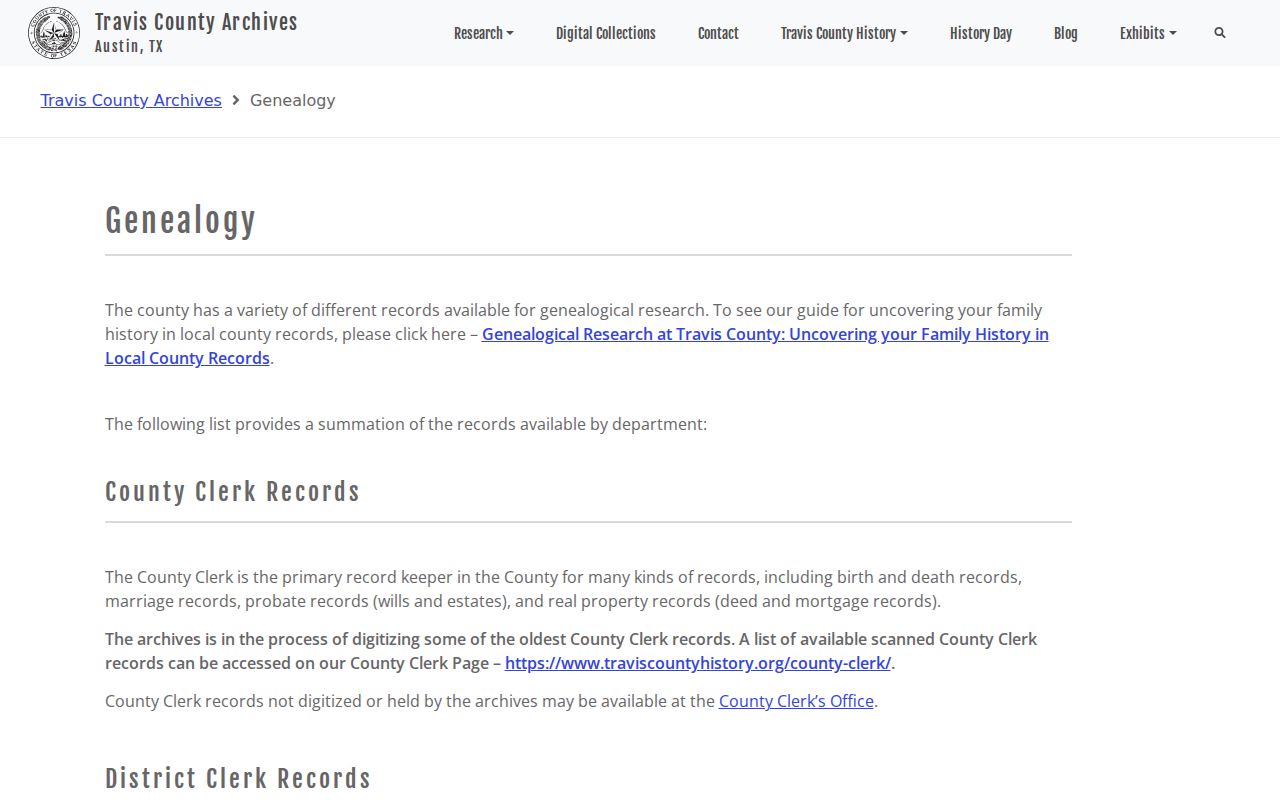
Austin Archives access is appointment-only at 5555 Airport Blvd, Room 507, Monday through Friday from 8 to 5 according to the Archives contact page. Its holdings mix books, microfilm, and digital records, so ask about the specific series and edition before a visit.
The same Austin archive contact route links to Preservica and notes no fee for archive copies, subject to the office's current handling rules. Appointment research, a digital archive search, the library shelf, and State Library microform are complementary access channels, not interchangeable substitutes.
Austin Cemetery and Archive Cross-Checks
When two people share a name, an Austin city directory entry can be tested with a burial or archival record. The Austin History Center cemetery database is ledger-derived and mainly covers Oakwood burials from 1866 to 1921. It can show name, burial date, age, birthplace, burial location, section, lot, space, profession, and remarks when those fields exist. Historical vocabulary in a ledger can be outdated, so retain source context without repeating unneeded labels.
The Austin History Center cemetery database provides a searchable historical cross-check for city directory research.
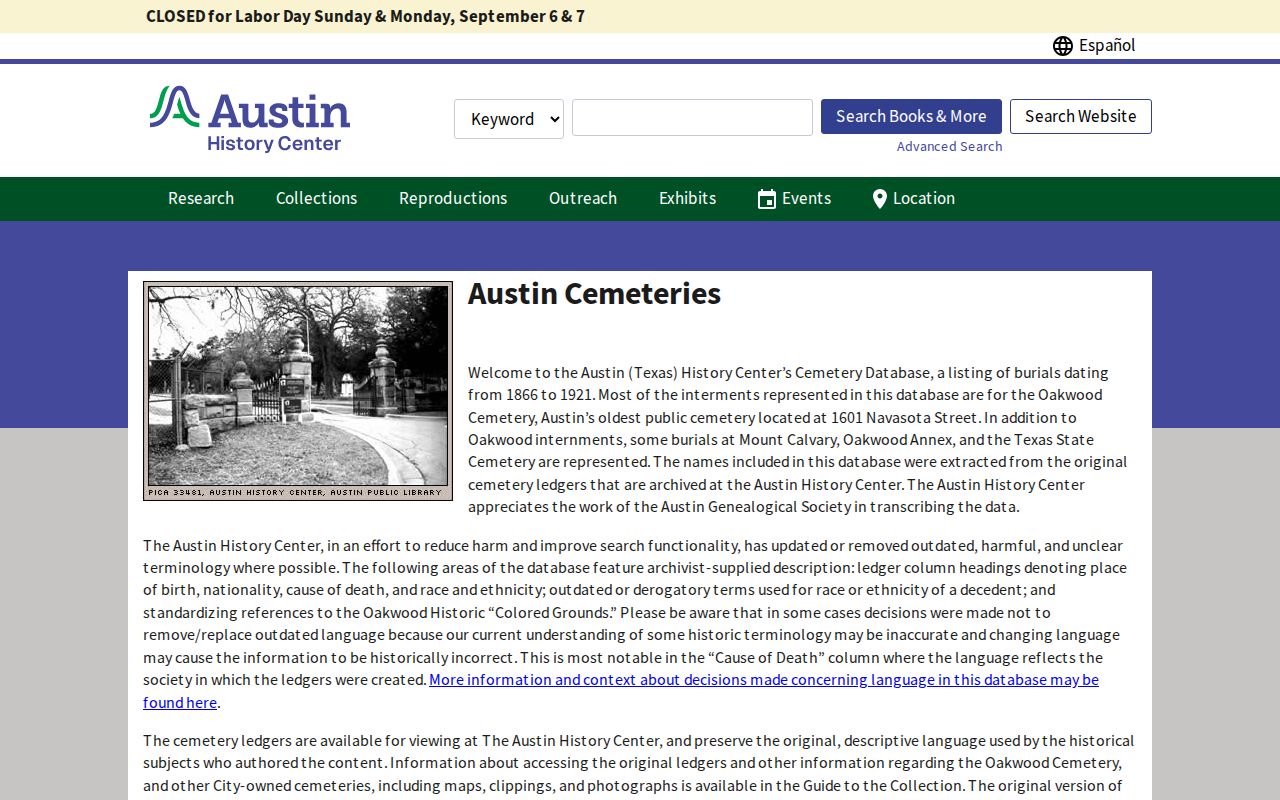
An Austin burial record is evidence of an interment and its recorded details. It does not establish a current household or a complete family relationship on its own.
City of Austin cemetery information supplies the municipal cemetery and gravesite-assistance route.
The City operates Austin Memorial Park, Evergreen, Oakwood, Oakwood Annex, and Plummers, and maintains Longview Park and Stanley-Nolen. Oakwood was established in 1839, adding local context when a directory trail reaches the cemetery ledger era.
Trace an Austin Household Through Directories
Use a household trail one edition at a time. A directory disappearance can reflect a move, a death, a listing choice, a gap in the run, or a change in spelling. Austin census material available through the Austin History Center and HeritageQuest adds a dated household snapshot, subject to its own boundary and transcription limits. The goal is to preserve a sequence of sources, not to turn a single listing into a biography.
- Start with a known name or address in one dated Austin volume and capture the page, spelling, and section.
- Check the prior and later available editions, including the address cross-reference when the edition supplies it.
- Compare an address change against street renumbering, street-name changes, and the exact historical form of the address.
- Pair a directory year with the nearest available census, yearbook, cemetery, obituary, probate, or archival record.
- Record what each source says separately and label any remaining same-name match as uncertain.
For a modern address-keyed record chain, the Austin street directory route uses property, GIS, and recorded-instrument sources rather than rebuilding the historical shelf.
Austin Directory Years in Record Eras
Austin's historical materials span several record eras. Early county deed and marriage books are followed by late nineteenth- and early twentieth-century naturalization and land records, then city and telephone directories during the streetcar and automobile periods. Sanborn maps and permit records add building and lot context during neighborhood build-out. Modern GIS and digital court systems serve different questions entirely. This layered history explains why a no-result online often means the requested year belongs in microfilm, a book, or an archive series.
| Period | Useful Austin record layer | What to preserve |
|---|---|---|
| 1872 forward, with gaps | City directories and later telephone directories | Edition, page, section, spelling, and address as printed |
| 1885-1971 selected runs | Austin Sanborn maps and later updates | Building, lot, use, and map date, not household identity |
| 1840-1995 selected Archives series | Tax rolls and related County Archives material | Series name, date range, and access format |
Austin grew from a 2020 census population of 961,855 to a 2024 estimate of 993,588 in the reviewed QuickFacts source. That scale helps explain why current portals and older gap-filled collections must be treated as separate systems with separate coverage.
The last printed Austin-directory year was not located in the official sources reviewed. Keep that uncertainty in the research note rather than treating a later catalog listing or an online gap as a final publication date. The best citation keeps the repository, edition, page, and access format together.